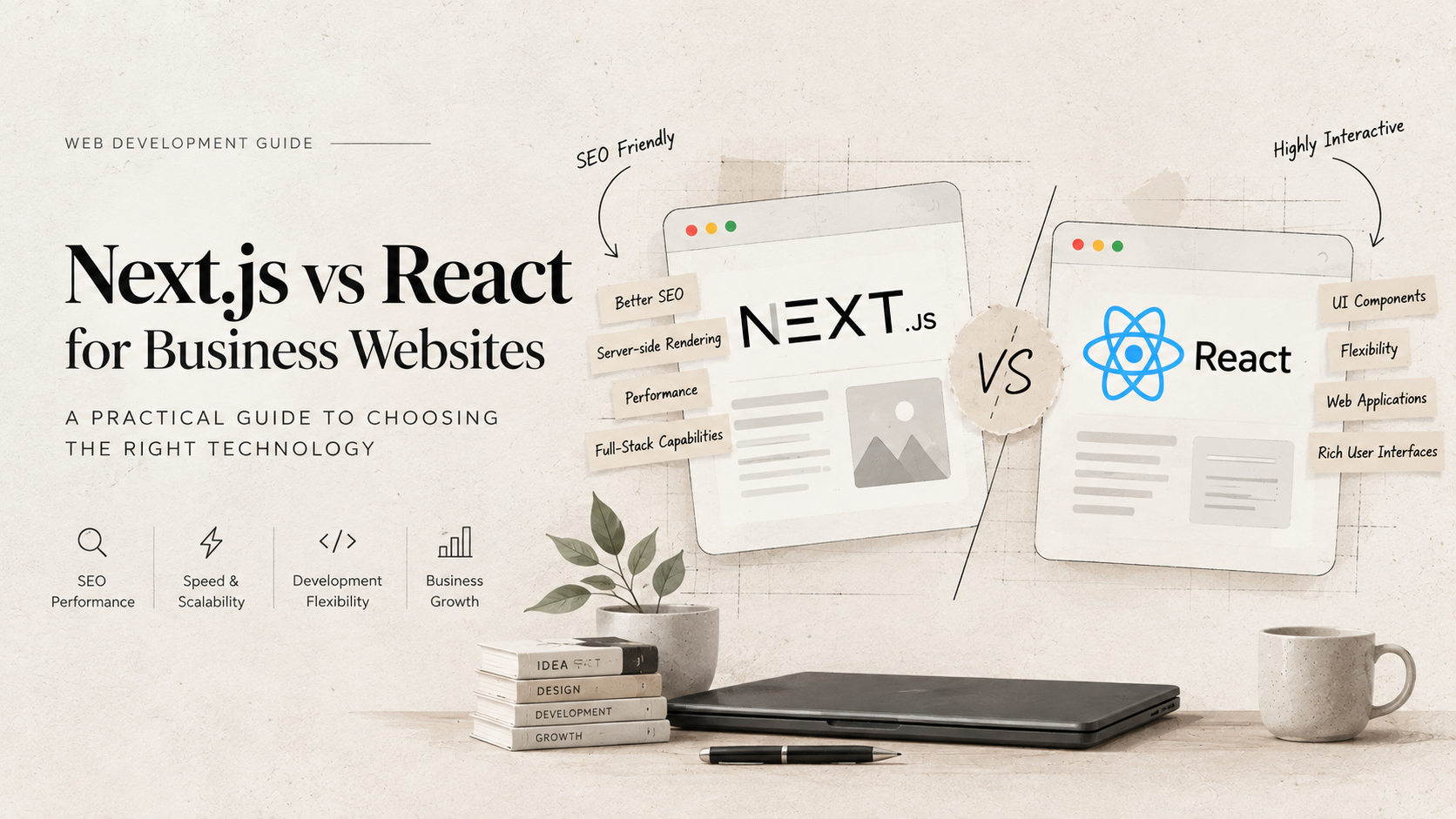
If you are planning a new business website, you may come across two names very quickly: React and Next.js. Both are widely used in modern web development, but they solve slightly different problems.
The important question is not simply whether React or Next.js is better. The better question is which technology fits the website, SEO requirements, content structure, performance goals and future functionality your business actually needs.
At YNS Web Studio, we use React and Next.js for different types of projects. This guide explains how we think about that decision when building websites and web applications.
React and Next.js are related, but they are not the same thing
React is a JavaScript library for building user interfaces. It gives developers a component-based way to create interactive frontends. Next.js is a framework built around React that adds application-level capabilities such as routing, rendering strategies, server-side features and a structured approach to building complete web applications.
That distinction matters for business websites. A React project can be an excellent choice when the main requirement is a rich client-side interface or application. Next.js becomes particularly useful when the project needs a stronger website architecture around content, SEO, routing, performance and server-side functionality.
When React is a strong choice
React is a strong fit when the core product is an interactive application rather than a large search-driven content website. Dashboards, authenticated interfaces, internal tools and highly interactive frontends can benefit from React's component model and ecosystem.
- Interactive dashboards and admin panels
- Customer portals and authenticated interfaces
- Single-page application experiences
- Complex front-end interfaces with reusable components
- Projects where the frontend consumes an existing API
When Next.js is a strong choice for a business website
For a public-facing business website, Next.js can provide a more complete foundation. This is especially useful when organic search, page structure, performance and scalable routing are important parts of the project.
- Business websites targeting Google search
- Service websites with multiple SEO-focused pages
- Content-heavy websites and blogs
- E-commerce and product websites
- Marketing websites for SaaS and startups
- Web applications that need both public pages and application functionality
Next.js vs React for SEO
SEO is often one of the biggest reasons a business considers Next.js. React itself does not prevent a site from ranking, but the architecture of a typical client-rendered application can require more care when search visibility is a major objective.
Next.js gives developers more rendering and routing options for creating pages that are easier to structure for search engines and users. That makes it a practical choice for websites where individual service pages, landing pages, articles and other public URLs need to be discoverable and performant.
Next.js vs React for website performance
Performance depends on much more than the framework. Images, JavaScript size, fonts, third-party scripts, API calls, caching, page structure and hosting all matter.
The advantage of using Next.js is that the framework gives a team more tools and conventions for building different parts of a website efficiently. The final result still depends on implementation quality. A poorly built Next.js website can be slower than a well-built React application.
What we would choose for different projects
| Project type | Typical choice | Why |
|---|---|---|
| SEO-focused business website | Next.js | Strong fit for public pages, structured content and search visibility |
| Marketing website with a blog | Next.js | Useful for scalable content and route architecture |
| Interactive dashboard | React | Excellent fit for complex client-side interfaces |
| Customer portal | React / Next.js | Depends on whether public SEO pages are part of the product |
| E-commerce website | Next.js + React | Combines React UI with a broader website/application framework |
| SaaS product | Next.js + React | Useful when marketing pages and the application live in one product |
The technology should follow the business requirement
Choosing a framework because it is trending is rarely a good development strategy. A business website should start with its goals: how customers will find it, what pages they need, what actions users should take, how much content will be published and what functionality may be added later.
For a search-focused business website, Next.js is often a strong option. For an application dominated by interactive UI, React can be an excellent fit. In many real projects, the two are not competing technologies at all: Next.js provides the application framework while React powers the interface.
Looking for React or Next.js website development?
YNS Web Studio builds React and Next.js websites for businesses, startups and brands, with attention to responsive design, technical SEO, performance, clean architecture and conversion-focused page structure.
Still deciding what technology your website needs?
Share your idea, existing website or business requirements and we'll help you understand the best direction.
Have a website idea?
Let's build it properly.
We build modern websites focused on performance, usability, SEO and business results.